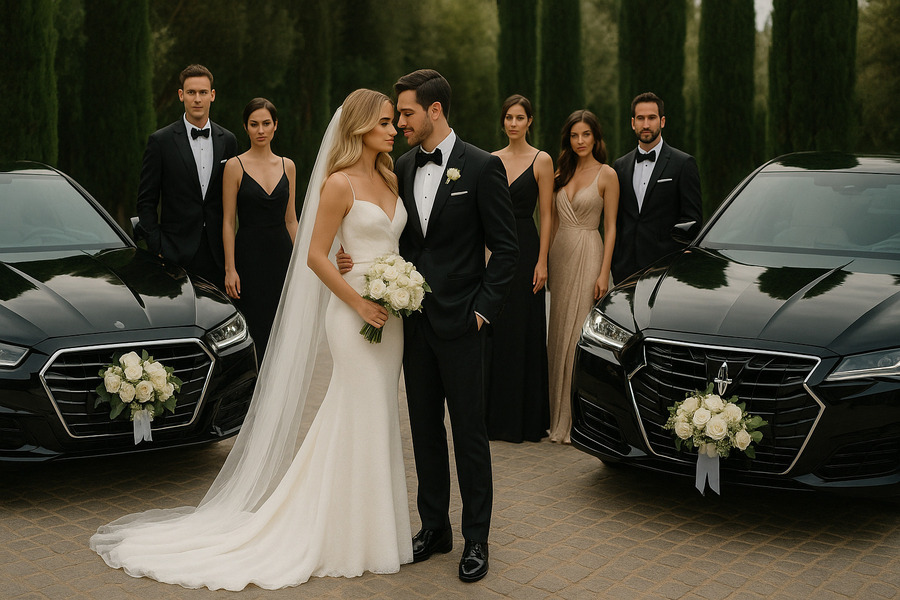

Your wedding, a moment forever etched in your memory
The wedding day is often considered the’one of the most memorable moments of a life. It is an event where emotions, expectations, traditions, and a keen attention to detail intertwine. Behind the apparent magic of the celebration lies an extremely precise wedding organization, a series of decisions that directly influence the flow of the day and the experience of the guests.
Among these decisions, the transportation of guests has become a central element in the preparation of the modern wedding. While in the past everyone traveled to the venue in their own vehicle, today's couples are increasingly considering a transportation solution for their guests that is harmonized, coordinated and designed for everyone's comfort. The reasons for this evolution are numerous: remoteness of venues, traffic constraints, protection of guests, risks associated with alcohol, desire to create a convivial atmosphere from the start of the day, or even the desire to offer a smoother experience to loved ones.
This reflection raises a crucial question: is it better to centralize transportation for guests or let everyone travel freely? Behind this question lie two very different visions of wedding organization. In one, the bride and groom handle all the transportation logistics themselves, often through a... bus or coach dedicated. In the other, they let guests arrive on their own, offering great freedom but less control over the whole.
To answer this question, it is necessary to thoroughly examine the advantages, limitations and hybrid alternatives, while taking into account the type of event, the number of guests and the specific characteristics of the venue.
The wedding: an emotional, logistical and collective event
A wedding is not just a romantic or symbolic event; it is also a a true logistics project. The bride and groom organize a complete itinerary for their loved ones: welcome, ceremony, cocktail hour, dinner, dance party, sometimes even brunch the following day. Each of these stages requires travel or coordination.
Transportation for guests plays a direct role in the success of the event. A late arrival of a group of guests, a full parking lot, relatives getting lost along the way, a grandmother who can't find her car, or guests who don't want to drive home after the party can quickly turn a festive occasion into a stressful challenge. Smooth transportation dictates the pace of the wedding.
Today, many weddings no longer take place in a single location. It is common to see a civil ceremony at a town hall, a religious or secular ceremony at a second location, followed by a cocktail reception and an evening party at an estate, sometimes located in the countryside, far from major roads. This multiplication of places highlights the need to consider the transportation of guests.
Added to this are societal changes: weddings bring together guests from other regions, sometimes even other countries. Some are unfamiliar with the area, others don't own a vehicle. It's not uncommon for several guests to arrive by train or plane, sometimes even without a driver's license. Transportation then becomes a key responsibility the bride and groom.
Another important factor is safety. Since alcohol is frequently present at weddings – champagne, wines, cocktails, digestifs – the question of the return trip is crucial. Many couples today want to to offer a solution which limits the risks of driving after a lively evening.
Finally, transportation is part of the overall experience the bride and groom want to offer. Some couples choose to start the festive atmosphere right from the journey, with a friendly bus, music, a personalized welcome, or even light entertainment. Transportation no longer becomes a simple transition, but a... moment of cohesion.
In this context, let us now look at the advantages of a centralized organization of guest transportation.

The advantages of centralized transport: punctuality, safety, user-friendliness
Centralizing guest transportation involves setting up a organized system, usually in the form of’coach, minibus or a fleet of vehicles, allowing for manage all of the day's journeys. This solution is attracting more and more couples because it allows for a Total control over movement, but also enhanced security.
💡 The first major advantage is the punctuality. When all the guests travel together in the same vehicle, they arrive at the various key moments of the wedding together. This avoids individual delays, unexpected traffic jams for some, GPS errors, or parking difficulties. The ceremony starts on time, the photo session isn't delayed, and the cocktail hour unfolds with perfect timing. Smooth organization is a source of immense peace of mind for the bride and groom.
💡 The second advantage is the security. The act of offering centralized transport reduced This drastically reduces the risk of accidents related to fatigue or alcohol consumption. Guests don't have to drive home after a potentially very festive evening. They are taken care of from beginning to end, which reassures not only the bride and groom but also their loved ones. For remote locations, rural areas, or poorly lit country roads, this solution becomes even more relevant.
💡 The third advantage is the conviviality. The journey becomes a shared experience. Guests reconnect, chat, laugh, and begin to build a group dynamic from the very first moments. For distant relatives or long-time friends, it's the perfect opportunity to get together. Some couples also enjoy personalizing the transportation: a welcome card, music, a guide to tell the story of the couple or the estate, a small humorous surprise. This helps create a warm and memorable atmosphere.
💡 Another often underestimated advantage is the stress reduction for the guests. They don't have to find their way around, look for a parking space, or come back late at night. They feel taken care of, which improves their overall comfort and emotional availability to fully enjoy the day.
💡 Finally, centralizing the transportation of guests can also be a eco-friendly choice. A full coach replaces several dozen individual cars, reducing the event's carbon footprint.
The disadvantages: loss of flexibility, costs and time constraints
While centralizing guest transportation offers many benefits, it also has some limitations that are important to consider.
🚫 The first is the loss of flexibility. All guests must adhere to a strict schedule, which isn't always convenient for families with young children, older people with different schedules, or those who wish to leave the party earlier or later. Centralized transportation imposes a framework which leaves no room for individual desires. It can also create slight pressure on guests who don't like being dependent on a group.
🚫 The second point concerns the cost. Renting a coach or several minibuses represents a additional budget in wedding planning. Some couples hesitate to add this expense to an already costly event. However, it should be noted that the cost is often very reasonable when it is put into perspective with the safety, serenity and quality of experience offered to guests.
🚫 The third limitation is managing unforeseen events. If a group of guests wants to take a detour, stop at an intermediate hotel, or arrive at the venue later, centralizing transportation becomes more complex. Adapting a coach to specific situations can be difficult. Similarly, if the wedding spans several days with different highlights, the logistics can become more cumbersome.
🚫 Finally, some guests simply prefer to maintain their independence. They want to be able to arrive at their own pace, have their own vehicle to get around freely, or organize their own return journey. A centralized solution may be perceived as too directive for these individuals.
When to opt for a mix: main shuttle + a few personal vehicles
To meet the needs of a diverse group, a hybrid solution often becomes the smartest: to provide centralized transportation for the majority of guests and allow a few guests the option of using their own vehicles.
This model works particularly well when there is:
- many guests coming from far away or unfamiliar with the region
- an isolated, difficult-to-access area
- a significant age difference within the group
- guests staying in several different accommodations
- a desire to ensure security while allowing a certain degree of freedom
The main shuttle provides the general fluidity, guarantees essential schedules, secures the return at night and enhances conviviality. On the other hand, some personal vehicles can offer flexibility to families with specific constraints, very independent guests, or service providers who require a vehicle.
This hybrid approach enhances the overall experience: the bride and groom retain control of the main logistics, while respecting the individual comfort of certain guests. It also allows for limit costs, since a single coach or minibus may be sufficient, supplemented by about ten personal cars.
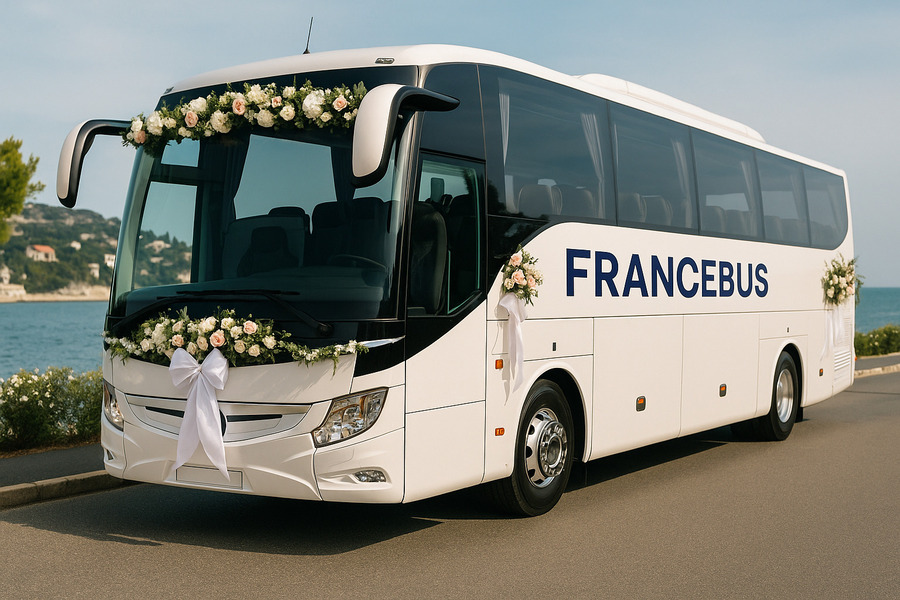
FranceBus Wedding recommendations based on venue type and number of guests
The FranceBus Wedding team accompanies couples each year in their wedding planning, by offering them suitable solutions regarding the transport of guests. Depending on the layout of the venue, its accessibility and the number of guests, recommendations may vary greatly.
⭐ For weddings in city center, centralized transport is often essential. Parking is scarce, traffic is heavy, and guests risk getting lost. A coach or minibus allows for strategic stops, avoids difficult areas, and ensures a safe return. security.
⭐ For weddings in a isolated area, In the mountains or in the countryside, centralization also becomes a excellent solution. Narrow or poorly lit roads can be dangerous. coach or minibus with a professional driver Being used to this type of journey guarantees a Total tranquility.
⭐ For weddings large scale With over one hundred guests, FranceBus Wedding generally recommends a regular shuttle system. This helps to streamline arrival, avoid traffic jams at the entrance to the venue and offer several return options during the night.
⭐ For the small weddings or intimate weddings, One or two minibuses may suffice. This solution is ideal for maintaining a friendly atmosphere while facilitating travel between different parts of the day. For weddings where guests are coming from several hotels, a customized service is offered, with multiple coordinated departure points.
⭐ Finally, for weddings long duration including brunch the following day, it is perfectly possible to set up two separate transport plans: one shuttle for the evening and another for the returns the next day.
FranceBus Wedding's objective remains the same: to guarantee a wedding fluid, secure, user-friendly and memorable, by providing solutions tailored to the context and desired style.
Why choose Francebus Wedding?
Francebus Wedding is a transport provider Established for many years. Recognized for the quality of its services, Francebus Wedding offers a fleet of various vehicles to meet your needs as perfectly as possible:
- Minivans: 8 seats
- minibus: 19 seats
- Coaches: 49 seats and more
- "High-end" sedans«
Choosing Francebus Wedding means to ensure :
✅ comfort
✅ safety
✅ punctuality
✅ serenity
✅ Quality of services
Examples of pricing: (prices without obligation)
| Pick-up location | Drop-off location | Vehicles | Prices |
|---|---|---|---|
| Hotel | Ceremony venue | Coach | € |
| Ceremony venue | Reception venue | Coach | € |
| Restaurants | Hotel | Minibus | € |
| Airport/Train Station | Ceremony venue | Minibus | € |
| Evening shuttles: reception venue | Hotel | Minibus | € |
Request your free quote online.
Discover the wedding trends of 2026.
Discover how to ensure your guests' comfort during transport.